Press-On Nails vs Gel Extensions: Cost, Damage & Wear Time Compared
Salon gels or premium press-ons? We compare real costs in India, damage to natural nails, wear time, and convenience — so you can decide what fits your life.

If you love a finished set of nails but flinch at the salon bill — or the two hours in the chair — you've probably asked the question every nail lover in India is asking right now: can press-on nails really replace gel extensions? The short answer: for most people, most of the time, yes — and the maths isn't even close. The longer answer is worth reading, because the two options genuinely suit different lives, and choosing right saves you money, time, and the health of your natural nails.
This is a complete, honest comparison: real costs in Indian metros, what each option does to your natural nails, how long each actually lasts, the time commitment, how the finish compares in 2026, and a simple framework for choosing. No spin — there are cases where gels win, and we'll name them.
The quick verdict
- Choose gel extensions if you want one untouched set for 4+ weeks, you don't mind ₹2,000–3,500 per visit, and your natural nails tolerate repeated filing and removal.
- Choose press-ons if you value your natural nails, want salon finish at one-tenth the yearly cost, like changing looks often, or simply cannot keep giving up two-hour salon slots.
Now the detail.
Cost: the maths is not close
What gel extensions actually cost in India
A gel extension appointment at a reputable salon in Mumbai, Delhi, Bengaluru, or Hyderabad typically runs ₹1,500–₹3,500 depending on the salon tier and any nail art. But the sticker price is only the start:
- Refills every 2–3 weeks: ₹800–₹1,500 each
- Removal: ₹300–₹800 (and skipping professional removal is how nails get wrecked)
- Repairs for a cracked or lifted extension: ₹150–₹400 per nail
- Travel and time — unpriced, but real
A conservative year of continuous gel wear — one full set plus refills on a normal cycle — lands between ₹25,000 and ₹40,000. Wedding-season art pushes it higher.
What a year of press-ons costs
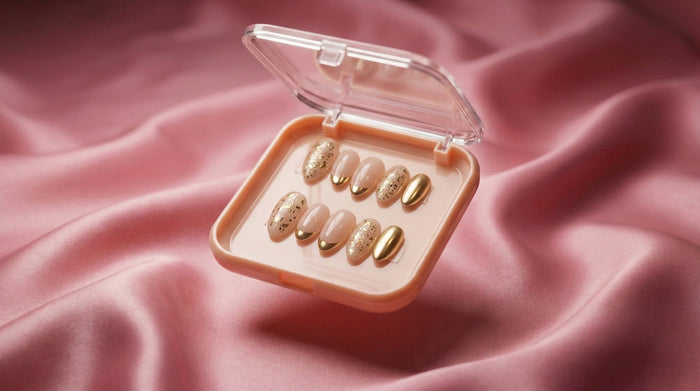
A premium press-on set costs a fraction of a single salon visit. Even wearing a fresh set every two weeks — 26 sets a year, with zero re-wearing — you'd spend a small slice of the gel budget. Factor in that a properly removed NailZen set survives two to three wears, and the real-world annual cost drops further. There are no refills, no removal fees, no repair charges — a popped nail is a 30-second re-glue at home.
For most wearers the honest ratio is roughly 8–10× cheaper per year for an equivalent always-manicured look.
Damage: what each does to your natural nails
The gel extension cycle
Gel extensions bond to a natural nail that has been buffed down — deliberately thinned — so the product grips. Removal involves e-file drilling, long acetone soaks, or both. Done perfectly, the damage is modest; done on a schedule, by varying technicians, month after month, the compounding is what hurts. Most long-term gel wearers know the signs: bendy, papery nails, white patches, peeling layers — and the dreaded "recovery break" where you go bare for a month to let your nails rebuild.
The press-on cycle
Press-ons sit on top of your natural nail, attached with adhesive. The prep is a light buff — taking the shine off, not thinning the plate. Removal is a warm oil-and-soap soak; no drills, no acetone baths. Removed properly, your nails come out exactly as they went in. There is no recovery period because there is nothing to recover from.
One honest caveat: press-ons can damage nails — if you rip them off. Peeling a glued press-on takes the top layers of nail plate with it. The soak-removal method in our application guide is non-negotiable. Follow it and the damage comparison isn't a comparison at all.
Wear time: closer than you think
Gels win on raw longevity — 3–4 weeks before a refill is standard. A well-applied press-on set delivers 10–14 days. On paper that's a gap. In practice, it matters less than it seems, for two reasons:
First, gels don't really last 4 weeks — they last 2–3 weeks attractively. By week three you're looking at visible regrowth at the cuticle and booking the refill anyway. The "maintenance-free month" is mostly theoretical.
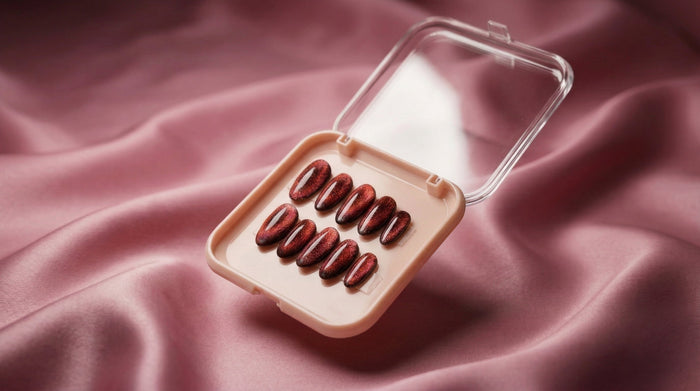
Second, most of us want to change looks more often than monthly. Press-ons turn the shorter cycle into a feature: deep reds for a wedding weekend, quiet office nudes on Monday, something glittery for Diwali week. With gels, every change is a paid appointment; with press-ons it's fifteen minutes at home.
Time: two hours versus fifteen minutes
A gel appointment is a 2–3 hour commitment door to door, booked days in advance, repeated every two to three weeks indefinitely. Over a year that's 30–50 hours in the chair — more than a working week.
A press-on application is fifteen minutes on your sofa, at 11 pm, the night before a morning flight. There is no booking, no travel, no waiting for a slot during wedding season when every salon in the city is overrun. For brides, frequent travellers, new mothers, and anyone with an unpredictable calendar, this is usually the deciding factor.
Finish and looks: the gap has closed
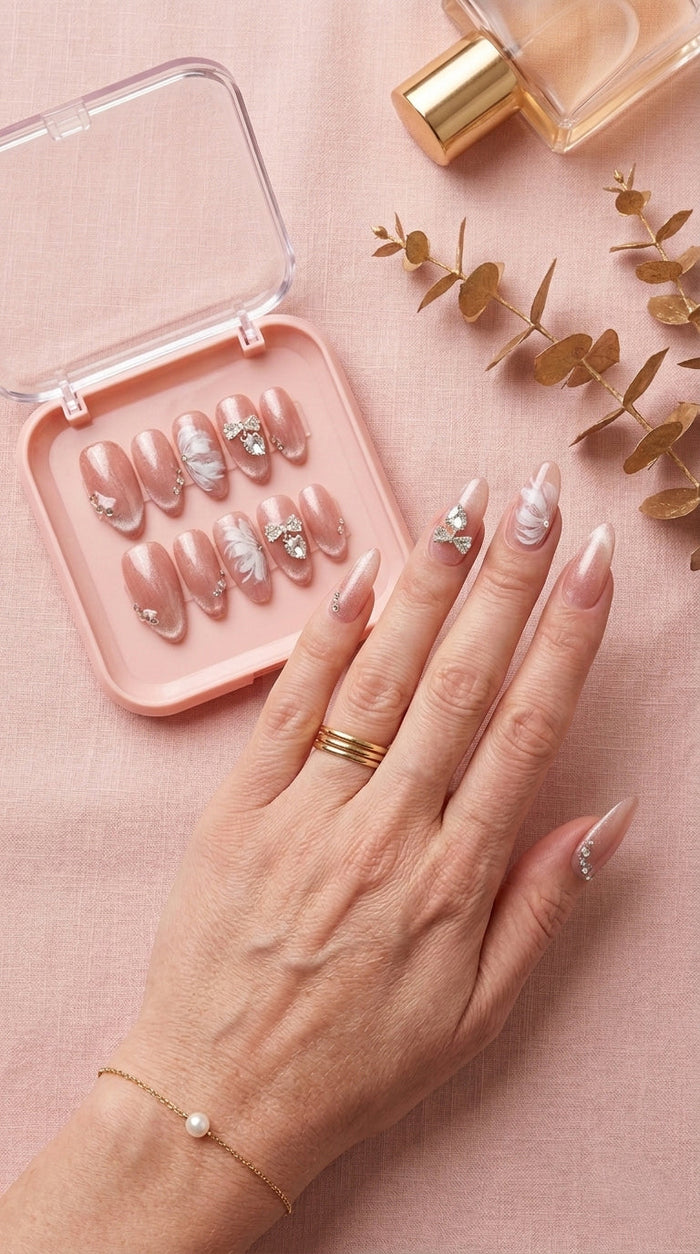
Five years ago, "press-ons" meant flimsy, too-shiny plastic in one universal pink. That era is over. Premium press-ons are made with the same gel materials salons use, cured and finished with proper top coats, and cut in multiple sizes per finger for a custom-fit look. NailZen sets are designed and tested on Indian skin tones specifically — so the nudes are your nude, not a Scandinavian factory's guess.
Where salon gels still genuinely win: complex one-off custom art painted to your exact brief, extreme lengths, and structural corrections for damaged nails. If your look is bespoke 3D art on XL stilettos, a good nail artist earns the price. For everything else — French tips, solid shades, ombré, classic art — nobody across a dinner table is clocking the difference. Our Art edit exists precisely because hand-finished detail now travels in a box.
Hygiene and safety
Two points worth knowing. First, UV curing lamps: gel appointments involve repeated UV exposure on the skin of your hands; dermatologists increasingly recommend SPF or fingerless gloves for frequent gel wearers. Press-ons involve no UV at all. Second, tool hygiene: extensions depend entirely on your salon's sterilisation standards. Press-ons are applied with your own hands, your own tools, at home.
When gels are the right call
Honesty corner. Book the salon when:
- You need one set to survive 4+ weeks untouched — a month-long trip where you'll do zero maintenance.
- You want bespoke art from a specific artist's hand.
- You have a nail-biting habit you're breaking and want something you physically cannot remove on impulse.
For the other 90% of occasions — weddings, festivals, office weeks, everyday polish — press-ons deliver the same look for less money, less time, and zero nail damage.
Making the switch: how to start
If you're coming off gels, give your natural nails a clean start: get the old set professionally removed, keep nails short, and oil daily for a week. Then begin with a forgiving everyday set — the Everyday edit or a classic from the French edit — and follow the application guide precisely on your first go. Most converts report the same arc: scepticism, surprise at day ten, and a drawer of sets by month three.
The bottom line
Gel extensions are a recurring service; press-ons are a product you own. The service costs ₹25,000–40,000 a year, consumes a working week of your time, and slowly taxes your natural nails. The product costs a tenth of that, takes fifteen minutes, swaps with your outfit, and leaves your nails untouched. That's why the switch is happening — not because press-ons are "good enough," but because for most real lives they're simply the better tool.
Frequently asked questions
Do press-on nails look fake compared to gel extensions?
Not anymore. Premium press-ons use the same gel materials and top coats as salons, with multiple sizes per finger for a fitted look. At normal length and shape, the two are indistinguishable in person and in photos.
How many times can I reuse a press-on set?
Removed with a warm oil soak rather than peeling, a quality set survives intact — most NailZen sets give two to three full wears. Clean off old adhesive and store nails in their tray between wears.
Are press-on nails OK for daily household work?
Yes — with the same caveat as any manicure: wear gloves for long hot-water jobs like dishes. Typing, cooking, and normal chores are no problem for a properly glued set.
Can I get press-ons in trendy shapes like almond, coffin, and stiletto?
Yes — press-ons come in every salon shape and length, and you can file a set shorter or softer in seconds without paying for a reshape.
Is it cheaper to do gel nails at home with a UV kit instead?
Home gel kits cost less than salons but keep the downsides: UV exposure, buffing damage, acetone removal, and a real skill curve. Press-ons skip all four — the learning curve is one application.
Will press-ons stay on during a wedding week with haldi and dancing?
Applied with glue on prepped nails the night before, yes — comfortably. Thousands of Indian brides now plan a different set per function; see our bridal nail guide for the function-by-function plan.